1. A Pungent Fruit
Few plants today have had as profound an impact on human nutrition as the chili pepper. Native to the Americas and domesticated thousands of years ago by indigenous Mesoamerican peoples, it is now an indispensable component of gastronomy across all continents. The importance of this fruit lies not only in its culinary versatility within exquisite dishes, but also in the enormous diversity of shapes, colors, flavors, and heat levels it has acquired through human selection (Hernández-Pérez et al., 2020).
While some varieties are virtually sweet, others reach staggering levels of pungency due to capsaicin, the chemical compound responsible for heat. Over recent decades, genetic breeding has led to the development of "superhot" chilis exceeding two million Scoville Heat Units (SHU), although many traditional landraces remain cherished primarily for their flavor, aroma, and culinary traditions.
Beyond its culinary prominence, the chili pepper has served medicinal, ritual, and cultural roles since pre-Hispanic times and remains an active subject of pharmacological research due to bioactive compounds such as capsaicin, carotenoids, and potent antioxidants (Hernández-Pérez et al., 2020).
2. Origin, Domestication, and Global Dispersal
The genus Capsicum originated in the Americas and comprises over forty chili species, five of which were domesticated by ancient human societies: Capsicum annuum, C. chinense, C. frutescens, C. baccatum, and C. pubescens (Figure 1) (Ibiza et al., 2012).
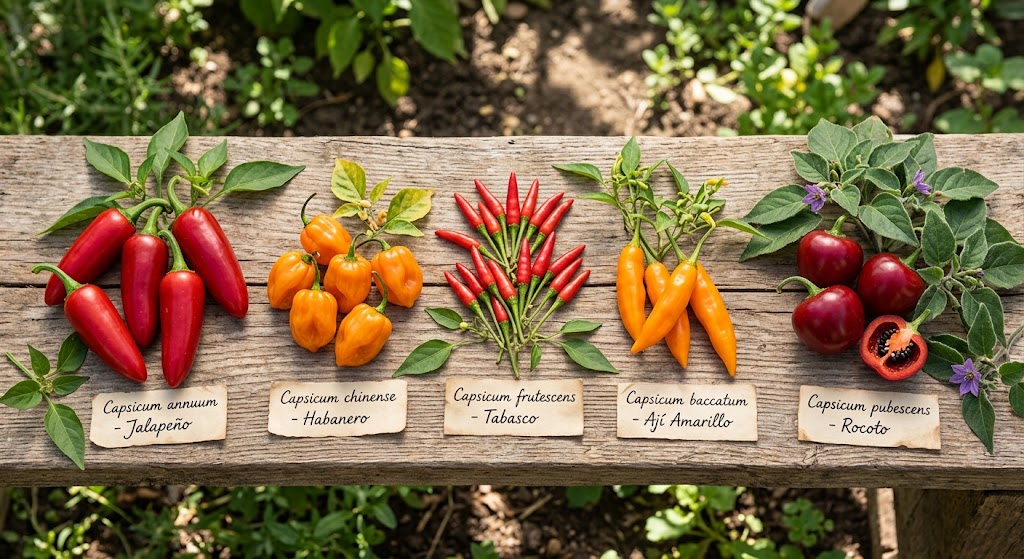
The most economically and agriculturally important species is C. annuum, encompassing renowned chilis such as jalapeño, serrano, poblano, guajillo, and ancho. Genetic evidence demonstrates that it was domesticated in Mexico from wild populations closely related to chiltepin more than six thousand years ago (Kraft et al., 2014). This antiquity is corroborated by macrobotanical and archaeological findings confirming the early use of chili alongside staple crops such as maize, beans, and squash (Perry et al., 2007).
Following European contact with the Americas, chili cultivation rapidly dispersed across Europe, Africa, and Asia along Spanish and Portuguese maritime trade routes. Today, chili peppers are central to cuisines worldwide—from India and China to Korea and Thailand—making it one of the American crops with the broadest global expansion (Hernández-Pérez et al., 2020).
3. Chiltepin: The Wild Ancestor
Chiltepin (C. annuum var. glabriusculum) is recognized as the closest wild progenitor of numerous cultivated chili varieties. Genetic analysis indicates that Mexican wild populations played a central role in the domestication trajectory of C. annuum (Kraft et al., 2014).
Today, chiltepin remains prized for its intense, fleeting heat and as a living bridge to the earliest agricultural innovations in Mesoamerica.
4. Botany of the Chili Pepper
Chili peppers belong to the Solanaceae family, which also includes tomatoes, potatoes, and eggplants. Their flowers give rise to botanical berries that display extraordinary diversity in shape, size, wall thickness, and pigmentation (Lozada et al., 2022).
A hallmark characteristic of the genus Capsicum is the biosynthesis of capsaicinoids—the secondary metabolites responsible for pungency. The predominant compounds are capsaicin and dihydrocapsaicin, synthesized primarily within the placental tissue of the fruit (González-Zamora et al., 2013).
5. Ecology and Evolution of Pungency
Capsaicin evolved as an adaptive defense strategy favoring plant reproductive success. Mammals possess receptors sensitive to capsaicin and tend to destroy seeds during mastication, whereas birds are largely insensitive to capsaicinoids, ingesting the berries whole and effectively dispersing viable seeds across wide territories (Tewksbury & Nabhan, 2001). Paradoxically, humans transformed this defensive chemical barrier into one of the most celebrated culinary traits, selecting and refining varieties with diverse heat profiles over millennia.
6. Ethnobotany: Food, Medicine, and Culture
In Mexico, chili holds an exceptional place in daily life, acting simultaneously as a foodstuff, traditional medicine, and cultural emblem. This profound relationship has led scholars to categorize it as a primary example of the "food-medicine continuum," where nutrition and health maintenance intersect seamlessly (Aguilar-Meléndez et al., 2021).
Across Mexican indigenous and rural communities, chilis are used to season foods, stimulate appetite, promote digestive motility, and provide thermogenic warmth. Furthermore, they feature in traditional spiritual protection and purification rituals.
This biocultural significance is mirrored in the conservation of hundreds of local landraces and regional dishes. Far more than a mere seasoning, chili forms a pillar of Mexican cultural and culinary identity (Aguilar-Meléndez et al., 2021).
7. Chili, Cacao, and Mesoamerican Ritual Beverages
The culinary bond between chili and cacao has deep ancestral roots in Mesoamerican history. Long before modern sweetened chocolate emerged, pre-Hispanic cultures prepared ceremonial cacao-based drinks infused with aromatic flowers, spices, and chili. According to Almaraz-Valle et al. (2026), archaeological and codical records document these concoctions in religious ceremonies, political alliances, and elite prestige settings. Cacao was a revered commodity and when blended with chili produced complex, bitter, aromatic, and invigorating beverages—a rich tradition predating European chocolate by centuries.
8. The World's Most Popular Chili
From an agronomic and commercial standpoint, C. annuum represents the dominant species globally, encompassing both spicy and sweet cultivars (Hernández-Pérez et al., 2020). Its worldwide supremacy stems from high ecological adaptability, genetic plasticity, and culinary versatility.
Prominent cultivars include jalapeño, cayenne, paprika, and bell peppers. The jalapeño has achieved universal fame due to its balanced flavor and moderate heat, while sweet bell peppers dominate the fresh vegetable commodity market.
Currently, China is the world's leading producer of chilis and bell peppers, while Mexico remains one of the paramount centers of genetic diversity and biocultural heritage for the genus Capsicum (Lozada et al., 2022).
9. What is the Scoville Scale?
Pungency intensity is quantified using the Scoville Scale, established by pharmacist Wilbur Scoville in 1912. This scale uses Scoville Heat Units (SHU), reflecting the concentration of capsaicinoids in the fruit.
Modern quantification employs High-Performance Liquid Chromatography (HPLC) to measure capsaicin and related analogs with analytical precision (González-Zamora et al., 2013). For reference, a bell pepper registers 0 SHU, while modern superhot chilis surpass two million SHU.
10. The World's Hottest Chilis
Over recent decades, specialized breeding programs have pushed pungency to extreme thresholds. Currently, Pepper X holds the recognized world record, followed by the Carolina Reaper, Trinidad Moruga Scorpion, and Bhut Jolokia (Figure 2).
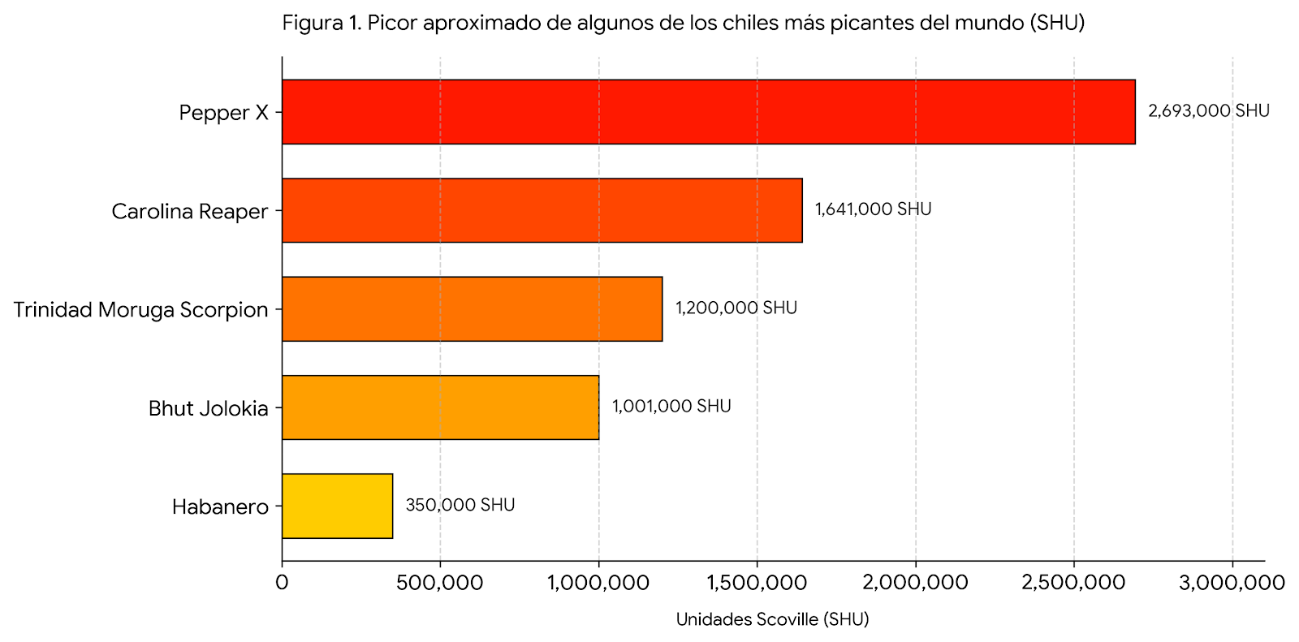
These values can vary depending on environmental conditions, crop management, and the genetic background of individual plants (González-Zamora et al., 2013).
11. Where Do Mexican Chilis Stand in the Pungency Ranking?
Although Mexico possesses very hot varieties, most indigenous landraces were historically bred for complex aroma, flavor depth, and culinary harmony rather than extreme capsaicinoid concentration.
The habanero, particularly that cultivated in the Yucatan Peninsula, stands as one of Mexico's most pungent and internationally celebrated chilis (Figure 3).
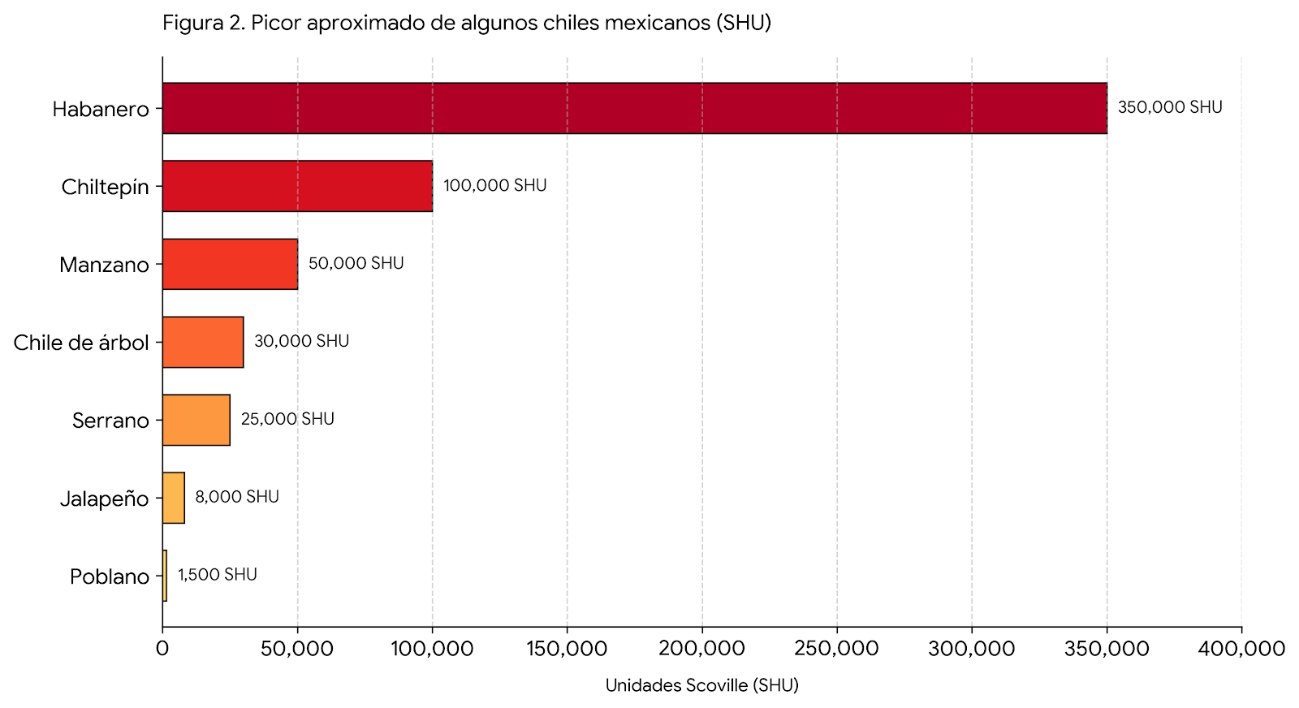
While Mexican varieties do not rival artificial modern superhots in pure SHU metrics, they excel globally in aromatic complexity and culinary versatility.
12. Diversity of Mexican Chilis
Over thousands of years, farmers selected varieties adapted to microclimates and regional culinary uses. Iconic varieties include jalapeño, serrano, poblano, guajillo, ancho, pasilla, chiltepin, habanero, manzano, and chile de árbol. Many change names according to processing and maturity; for instance, smoked jalapeño becomes chipotle, and dried poblano becomes ancho (Lozada et al., 2022).
13. Common Myths and Misconceptions
Numerous misconceptions surround chili peppers. A prevalent belief claims seeds are the hottest part of the fruit; in reality, capsaicin is primarily synthesized and concentrated in the placental tissue where seeds attach (González-Zamora et al., 2013).
Another myth suggests that chili inherently causes gastritis in all individuals; clinical evidence indicates tolerance depends on dosage, frequency, dietary patterns, and individual sensitivity (Mandal et al., 2022).
Finally, smaller chilis are not inherently hotter; fruit size does not dictate capsaicinoid concentration.
14. Conclusions
The chili pepper represents one of the most emblematic cornerstones of Mexican biocultural heritage. Its rich genetic diversity is intimately linked to agricultural traditions, culinary arts, and cultural practices developed over thousands of years.
Conserving native landraces entails protecting biological resources, rural livelihoods, and cultural memory. Chili is not merely a gastronomic seasoning—it is a living cultural legacy built by generations across the Americas.
Transparency Declarations
Author Contributions (CRediT): Víctor Manuel Almaraz Valle: Conceptualization, Writing – original draft, Methodology. Rafael Robles Pérez: Writing – review & editing, Validation. Adriana Bautista San Juan: Writing – review & editing, Visualization. Carlos Eduardo Aguilar Castillo: Investigation, Resources.
Funding: No external funding was received for this work.
Conflict of Interest: The authors declare no conflict of interest.
Artificial Intelligence Usage Declaration: The authors declare using Gemini (Google) as a generative artificial intelligence tool to assist in image drafting and content structuring. All generated outputs were thoroughly reviewed, edited, and validated by the authors, who assume full responsibility for the final manuscript.
References
- Aguilar-Meléndez, A., Vásquez-Dávila, M. A., Manzanero-Medina, G. I., & Katz, E. (2021). Chile (Capsicum spp.) as food-medicine continuum in multiethnic Mexico. Foods, 10, 2502. https://doi.org/10.3390/foods10102502
- Almaraz-Valle, V. M., Juárez-Maya, M. Á., & Bautista-San Juan, A. (2026). El cacao: semilla sagrada, moneda viva y legado cultural para las civilizaciones prehispánicas de Mesoamérica [Cocoa: Sacred seed, living currency, and cultural legacy for Mesoamerican pre-Hispanic civilizations]. Bioagrociencias, 19(1), 91–99. https://doi.org/10.56369/BAC.6876
- González-Zamora, A., Sierra-Campos, E., Luna-Ortega, G., Pérez-Morales, R., Rodríguez-Ortiz, J. C., & García-Hernández, J. L. (2013). Characterization of different Capsicum varieties by evaluation of their capsaicinoids content by high performance liquid chromatography, determination of pungency and effect of high temperature. Molecules, 18, 13471–13486. https://doi.org/10.3390/molecules181113471
- Hernández-Pérez, T., Gómez-García, M., Valverde, M. E., & Paredes-López, O. (2020). Capsicum annuum (hot pepper): An ancient Latin-American crop with outstanding bioactive compounds and nutraceutical potential. A review. Comprehensive Reviews in Food Science and Food Safety, 19, 2972–2993. https://doi.org/10.1111/1541-4337.12634
- Ibiza, V. P., Blanca, J., Cañizares, J., & Nuez, F. (2012). Taxonomy and genetic diversity of domesticated Capsicum species in the Andean region. Genetic Resources and Crop Evolution, 59, 1077–1088. https://doi.org/10.1007/s10722-011-9744-z
- Kraft, K. H., Brown, C. H., Nabhan, G. P., Luedeling, E., Luna Ruiz, J. J., d'Eeckenbrugge, G. C., Hijmans, R. J., & Gepts, P. (2014). Multiple lines of evidence for the origin of domesticated chili pepper, Capsicum annuum, in Mexico. Proceedings of the National Academy of Sciences, 111(17), 6165–6170. https://doi.org/10.1073/pnas.1308933111
- Lozada, D. N., Bosland, P., Barchenger, D., Haghshenas-Jaryani, M., Sanogo, S., & Walker, S. (2022). Chile Pepper (Capsicum) Breeding and Improvement in the Multi-Omics Era. Frontiers in Plant Science, 13. https://doi.org/10.3389/fpls.2022.879182
- Mandal, S., Rath, S. K., Logesh, R., Mishra, S., Devkota, H., & Das, N. (2022). Capsicum annuum L. and its bioactive constituents: A critical review of a traditional culinary spice in terms of its modern pharmacological potentials with toxicological issues. Phytotherapy Research, 37, 965–1002. https://doi.org/10.1002/ptr.7660
- Perry, L., Dickau, R., Zarrillo, S., Holst, I., Pearsall, D. M., Piperno, D. R., Berman, M. J., Cooke, R. G., Rademaker, K., Ranere, A. J., Raymond, J. S., Sandweiss, D. H., Scaramelli, F., Tarble, K., & Zeidler, J. A. (2007). Starch fossils and the domestication and dispersal of chili peppers (Capsicum spp. L.) in the Americas. Science, 315(5814), 986–988. https://doi.org/10.1126/science.1136914
- Tewksbury, J. J., & Nabhan, G. P. (2001). Seed dispersal: Directed deterrence by capsaicin in chilies. Nature, 412, 403–404. https://doi.org/10.1038/35086653