
1. A full silo can also be the snapshot of a failed market
There comes a moment each year when producers in the Bajío look at their harvested white maize crop and face a dilemma: sell at the available spot price or wait, risking further declines. Seed, fertilizer, water, energy, machinery, credit, insurance, harvest, and freight have already been paid. What remains unsettled is how much they will receive per ton. When these costs and intrinsic attributes are not recognized in negotiation, the farmer is left with the residual price of a chain whose decisions were made long before the grain reached the market. A surplus without a buyer suppresses the price.
Statistics help scale this contrast. For the 2026/27 crop cycle, the August 2026 WASDE estimates total Mexican maize production at 24.6 million tons, imports at 27.7 million tons, consumption at 53.4 million tons, and exports at a mere 20,000 tons. Between January and June 2026, Mexico imported 11.7 million tons of yellow maize and 493,000 tons of white maize (USDA, 2026; SADER, 2026a).
In the fields, this adjustment translates into pesos per ton. In February 2026, farmgate white maize in the Bajío stood around 4,800 pesos per ton: 22% less than a year earlier and, for many farmers, below production costs. Urea and diammonium phosphate alone represent, on average, 35% of production costs (USDA-FAS, 2026).
«A surplus without a buyer suppresses the price.»
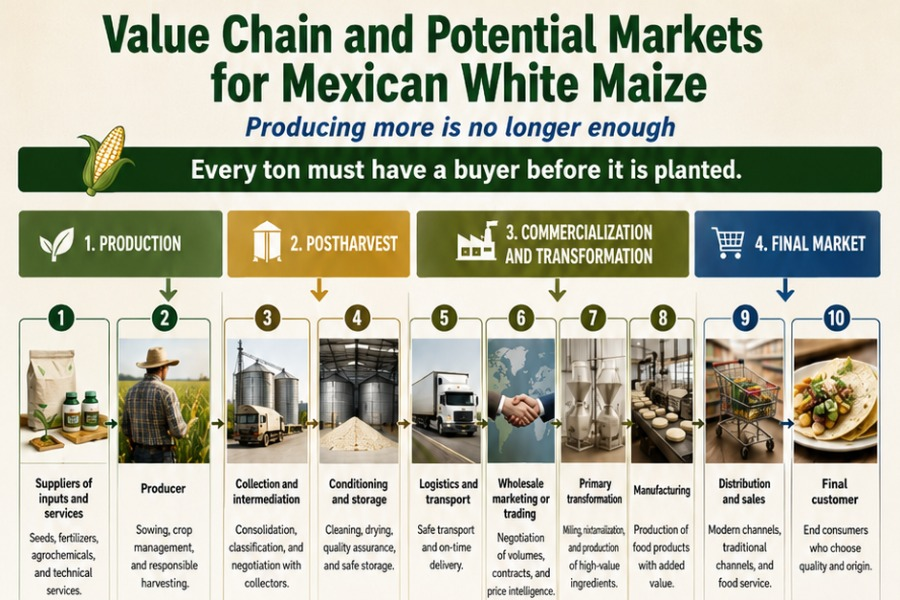
The proposal argued in this article rests on a fundamental principle: Mexico must first secure its domestic food needs without turning self-sufficiency into a ceiling on productive capacity. It can expand output by simultaneously building commercial channels capable of placing profitable surpluses abroad. Sequencing is vital: identify demand, negotiate conditions, contract; only then program production. Every ton must have a buyer before being planted.
2. From the center of origin to global markets: science and history share the same lesson
This history is supported by robust multidisciplinary evidence. Genetic studies led by Matsuoka placed the primary domestication origin of maize in Mexico; archaeological research directed by Ranere subsequently provided confirmation from the Central Balsas Valley (Matsuoka et al., 2002; Ranere et al., 2009).
From Mexico, the crop diversified and spread across Europe, Africa, and Asia. However, the international diffusion of hybrid cultivars required national scientists, seed certification systems, agricultural extension services, institutions, and farmers willing to adopt them (Byerlee, 2020).
This historical experience illuminates contemporary trade. For 2026/27, the USDA projects world maize production at 1,298.88 million tons and exports at 210.48 million tons. Nearly four out of every five exported tons originate from the United States, Brazil, and Argentina.
Volume explains only part of their dominance. These nations developed sophisticated mechanisms linking production with pricing, financing, risk mitigation, and commercial delivery:
- United States: Marketing contracts, futures, options, storage, and combined revenue and crop insurance (USDA-ERS, 2020; USDA-RMA, n.d.).
- Brazil: Barter arrangements to finance agricultural inputs against future crop deliverables and maize futures on B3 (Johann et al., 2017; B3, n.d.).
- Argentina: Futures, options, and basis contracts traded on Matba-Rofex (Matba-Rofex, n.d.).
- China: «Insurance + Futures» institutional model connecting insurance with futures markets to transfer price volatility (Liu et al., 2026; State Council of China, 2026).
- South Africa: Clear contractual distinction between white and yellow maize on the Johannesburg Stock Exchange backed by certified silo receipts (JSE, n.d.-a, n.d.-b).
3. White maize is not «just another grain»: value lies in demonstrating identity
For a milling facility, tortillería, or snack manufacturer, white color alone is insufficient. End-use specifications dictate hardness, moisture, color index, test weight, impurities, mycotoxins, and industrial yield. Selling generic «white maize» is akin to selling «metal» without specifying whether it is copper, aluminum, or steel.
USDA-FAS estimated 2025/26 production at 4.0 million tons in Jalisco, 2.0 million in Michoacán, and 1.7 million in Guanajuato, with over 80% classified as good or excellent quality (USDA-FAS, 2026). This latent quality must be converted into batch specifications, sampling protocols, laboratory assays, segregation, traceability, and contracts.
In March 2025, a constitutional reform strengthened native maize conservation and established national cultivation free of genetically modified maize (DOF, 2025). For foreign buyers, «grown in Mexico» and «certified Non-GMO» are distinct attributes that require third-party certification (Scoular, n.d.).
«Every ton must have a buyer before being planted.»
4. Chicago informs; Mexico must learn to formulate its own price
To understand what the producer truly receives, the price components must be broken down:
Basis measures the spread between local physical cash prices and benchmark futures (CME Group, n.d.). Chicago serves as a compass: it provides directional orientation, but does not dictate the physical cash value of food-grade white maize in Guanajuato, Jalisco, or Michoacán.
Therefore, we propose a Mexican Grain Markets System featuring transparent physical cash pricing, regional basis tracking, inventory monitoring, standardized contracts, certified storage, warehouse receipts, and integrated financing, insurance, forward contracting, and hedging.
5. From domestic supply to a global Mexican commercial network
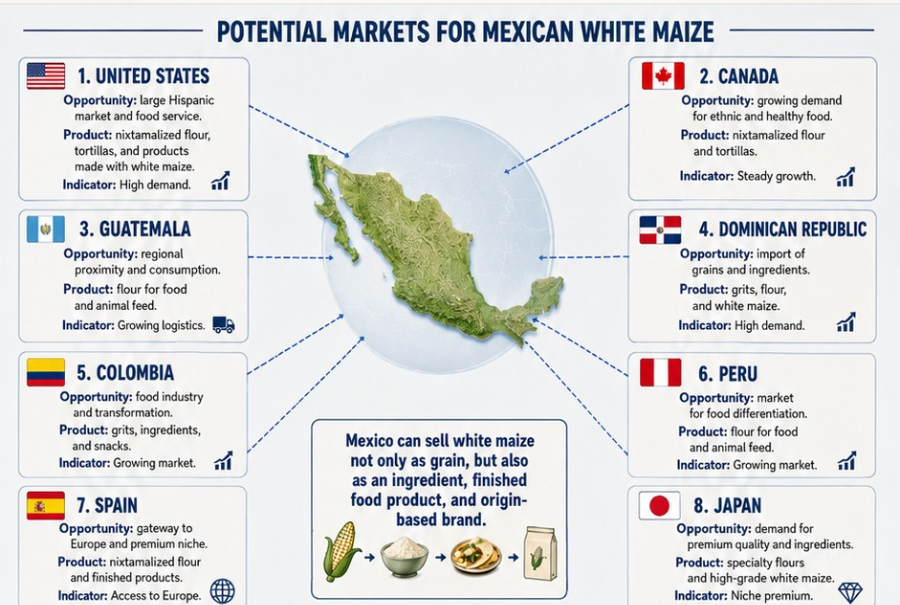
Exporting should not be an emergency exit for unsold surplus; it must be an operation engineered before sowing.
Mexico maintains 14 free trade agreements covering 52 countries, 30 investment promotion agreements, and 9 economic complementarity treaties, totaling 92 partner nations (Secretaría de Economía, 2026). This legal framework must be leveraged with international trade hubs and anchor buyers.
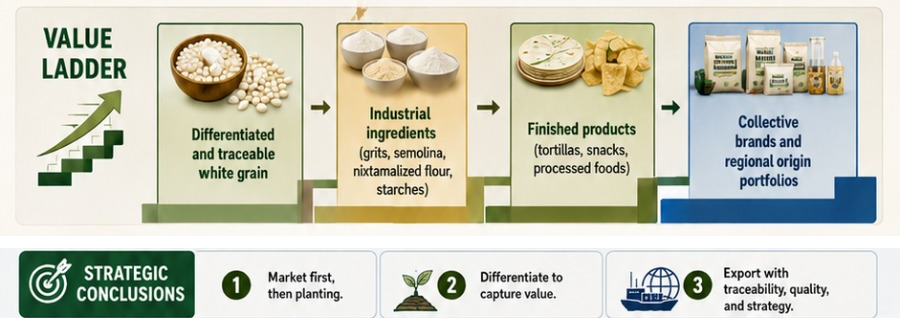
Supply must ascend the value ladder: from identity-preserved grain to specialty flours, starches, grits, prepared foods, and certified regional origin brands.
6. The quadruple helix must transform research into commercial contracts
- Academia: Train professionals in grain markets and hedging; characterize grain profiles; establish actionable standards.
- Government: Build public goods: reliable data systems, logistics infrastructure, phytosanitary standards, and hedging mechanisms.
- Industry: Share advance demand signals, establish clear forward contracts, and co-finance supply chains.
- Producers and Civil Society: Enterprise cooperatives, transparent governance, full traceability, and advance contractual negotiations.
«Record production at a loss is not competitiveness.»
7. Conclusion: every ton must have a buyer before being planted
Mexico taught the world how to domesticate and grow maize. It now faces an equally transformative task: commercial modernization. Increasing production is beneficial only when production, costs, quality, risk management, and markets are planned as an integrated system.
Food sovereignty must guarantee domestic food security. Commercial vision must achieve the companion objective: that centuries of agricultural heritage enable competitive surpluses that reach world markets profitably.
Mexico already knows how to produce maize. The defining question for the coming decade is: Do we want to continue selling whatever we harvest, or begin producing exactly what Mexico and the world are willing to buy?
Transparency Declarations
Author Contributions (CRediT): Conceptualization, Research, and Writing – original draft by Tristán Azuela Montes.
Funding: No external funding was received for this research.
Conflict of Interest: The author declares no conflicts of interest regarding this work.
Use of Artificial Intelligence: Research, argument formulation, and conclusions were developed by the author. Generative AI was used strictly as an auxiliary drafting and structuring tool under close author supervision.
Bibliographic References
- B3. (s. f.). Futuro de milho com liquidação financeira. b3.com.br
- Byerlee, D. (2020). The globalization of hybrid maize (1921). Journal of Global History. https://doi.org/10.1017/S1740022819000354
- CME Group. (s. f.). Learn about basis: Grains. cmegroup.com
- Consejo de Estado de China. (2026). China issues 5-year plan for agricultural modernization. gov.cn
- DOF. (2025). Decreto en materia de conservación y protección de maíces nativos. Diario Oficial de la Federación.
- Johann, A. R. G., et al. (2017). Operações de barter para financiamento em Goiás e Mato Grosso. Embrapa.
- Johannesburg Stock Exchange. (s. f.). Grain futures and options. jse.co.za
- Liu, C., et al. (2026). China’s «Insurance + Futures» model. Front. Sustain. Food Syst.
- Matba-Rofex. (s. f.). Futuros y opciones sobre maíz. matbarofex.com.ar
- Matsuoka, Y., et al. (2002). A single domestication for maize. PNAS, 99(9), 6080–6084.
- MexDer. (2023). Commodities: contrato de futuro del maíz amarillo y aviso de cancelación.
- Ranere, A. J., et al. (2009). Early Holocene maize and squash domestication. PNAS, 106(13), 5014–5018.
- Scoular. (s. f.). White corn: Identity Preserved & Non-GMO. scoular.com
- SADER. (2026a). Nota aclaratoria: importaciones de maíz primer semestre 2026. gob.mx
- SADER. (2026b). Sistema de Ordenamiento del maíz blanco «Precio Justo». gob.mx
- SADER. (2026c). Acuerdo de comercialización de maíz blanco PV 2026. gob.mx
- Secretaría de Economía. (2026). Tratados y Acuerdos Comerciales de México. gob.mx
- Unión Europea. (2003). Reglamento (CE) 1830/2003 relativo a la trazabilidad y etiquetado de OGM.
- USDA. (2026). WASDE Report August 2026. usda.gov
- USDA-ERS. (2020). Farm use of futures, options, and marketing contracts. ers.usda.gov
- USDA-FAS. (2026). Mexico: Grain and Feed Annual. Report MX2026-0018. fas.usda.gov
- OpenAI. (2026a, b, c). Infografías generadas mediante inteligencia artificial. ChatGPT.